


JRC HADES Underground laboratory for ultra-low level gamma-ray spectrometry
EUROPEAN COMMISSION’S JOINT RESEARCH CENTRE (JRC) IN GEEL, BELGIUM
The European Commission’s Joint Research Centre (JRC) provides independent, evidence-based science and knowledge, supporting EU policies to positively impact society. The JRC has six sites in five European countries: Brussels and Geel in Belgium, Ispra in Italy, Karlsruhe in Germany, Petten in the Netherlands and Seville in Spain.
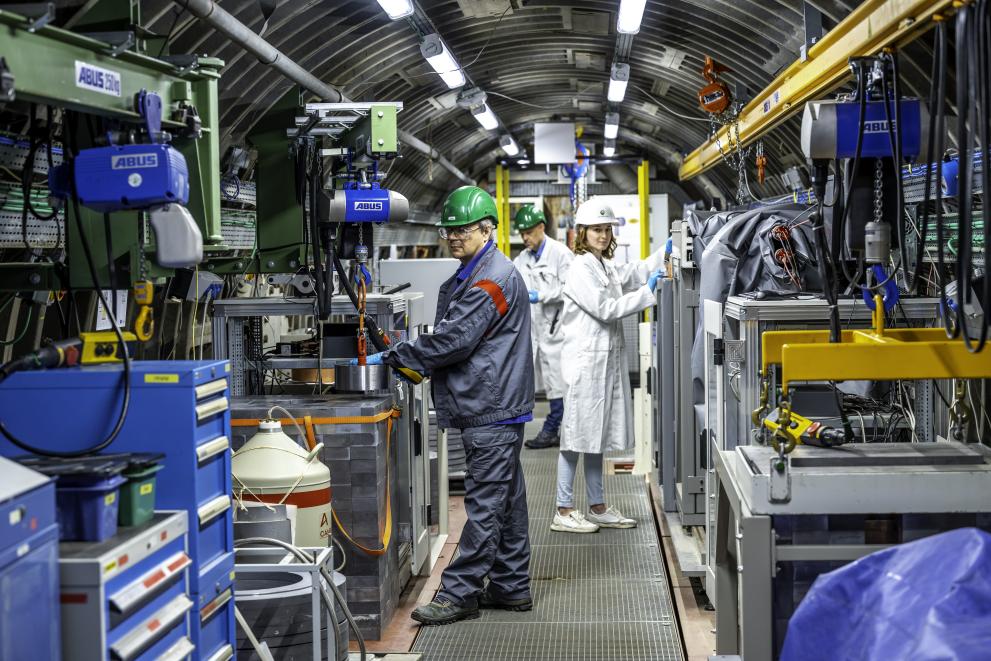
The JRC operates a laboratory for ultralow-level radioactivity measurements inside the 225 m deep underground laboratory HADES, which is operated by EURIDICE and located at the premises of the Belgian Nuclear Research Centre.
In HADES, the muon flux (secondary cosmic rays) is a factor of 5000 lower compared to above ground and the flux of protons, neutrons and electrons is reduced to an insignificant level. This reduction of the cosmic ray flux makes the background in gamma-ray spectrometry measurements significantly lower compared to above ground. Therefore it is possible to detect very low amounts of radioactivity, we are talking about levels of some hundred μBq (micro-Becquerel, i.e. a few nuclear disintegrations per day).
Eleven specially designed low-background gamma-ray detectors are used for the measurements. In addition there is the possibility of characterising the top deadlayer of a HPGe-detector by using a specially designed scanning system available in HADES.
Some examples of measurement project are:
- Tracing processes in nature like ocean currents and uptake in the food chain.
- Characterizing reference material used for environmental monitoring, food control and radioactive waste management and nuclear decommissioning.
- Retrospective dosimetry using neutron activation like was done for improved dose-assessment of Hiroshima victims by measuring building materials activated by the A-bomb
- Charge particle activation as a means of studying leakage from thermonuclear fusion plasma.
- Rare decay data: Recent work includes Nature’s rarest isotope and most long-lived isomeric state ( 180mTa) and the decay with the lowest beta decay energy ( 115In)
- Radiopurity determinations: checking of blanks, low-level samples, measurement containers and materials to be used for constructing detector
- Characterisation and testing of detectors
Some technical considerations
Measuring underground is not trivial. It is not simply to take an above ground detector and place it underground. In such case one measures only radioactivity from the detector or the shield. The lead shield need to be as old as possible to minimise the influence of 210Pb which has a half life of 22 years. In HADES we use lead from Versailles and Hampton Court (300-500 years old) as well as some 800 years old roof tiles from Het Pand in Gent. The copper in the shield needs to be as new as possible. It is transported from the Cu-factory with a truck immediately as it comes out from the factory and taken to an underground storage. This is to avoid activation by the cosmic radiation.
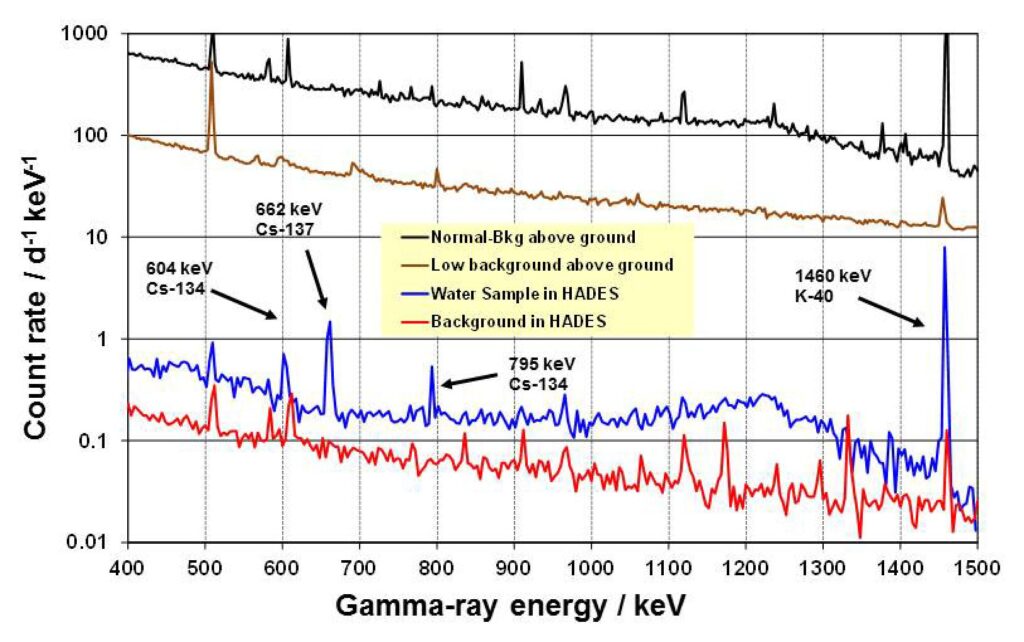
Typically mBq-levels of activity are measured in HADES. A mBq is about 1 decay per hour. Given that the detection efficiency varies between 1% and 10% it is clear that a sample needs long measurement time (typically 1 week). The main limitation of the technique is thus throughput. It is thus necessary to use a large number of detectors. At present there are 11 HPGe-detectors in HADES.
The full list of detectors and their specifics are available at the instrument webpage.
Access to the Joint Research Centre (JRC) is subject to special conditions and requirements that are summarized in the document Information for CERIC users requesting access to the JRC. Please read the document before requesting access to HADES through CERIC open access Calls for Proposals.
Contacts:
HULT Mikael – Mikael.HULT@ec.europa.eu
PELCZAR Krzysztof – Krzysztof.PELCZAR@ec.europa.eu
-
16.07.2026
JRC GELINA Neutron Time-of-Flight Facility