



JRC RADMET Radionuclide Metrology laboratories
EUROPEAN COMMISSION’S JOINT RESEARCH CENTRE (JRC) IN GEEL, BELGIUM
The European Commission’s Joint Research Centre (JRC) provides independent, evidence-based science and knowledge, supporting EU policies to positively impact society. The JRC has six sites in five European countries: Brussels and Geel in Belgium, Ispra in Italy, Karlsruhe in Germany, Petten in the Netherlands and Seville in Spain.
The radionuclide metrology sector was the first to be established at JRC-Geel in 1959 (at that time called CBNM – Central Bureau for Nuclear Measurements). Its main objective was the accurate measurement of radioactivity and decay properties of radionuclides. Over the last 57 years, this group has built up a reputation as one of the world’s leading laboratories in primary standardisation of radionuclides and SI-traceable radioactivity measurements. It has extended its work programme to characterisation of reference materials for radioactivity measurements, the organisation of intercomparisons among European monitoring laboratories, development of standards and development of source preparation techniques.
Measurements of radioactivity are becoming increasingly important in today’s society. Natural radioactivity is omnipresent and needs to be monitored to protect the health of the population and to understand processes in nature and industry. Anthropogenic (man-made) radioactivity is continuously produced in the nuclear industry and does not stop at borders if accidentally released. Nuclear medicine is developing rapidly and uses more radionuclides than ever before — an increase that will continue. Sustainability requires extensive recycling of materials which calls for robust measurements of radioactivity in scrap to minimise risks to society. All of this calls for harmonised measurement procedures and well-established calibrations in radioactivity monitoring laboratories.
Some of the key activities of the Radionuclide Metrology Sector are:
- Support of the Mutual Recognition Arrangement for national measurement standards and for calibration and measurement capabilities signed under the auspices of the Comité International des Poids et Mesures (CIPM) of the Metre Convention; cipm – BIPM
- Support to implementation of the Euratom Treaty Article 35 by performing regular controls of member states capacity to report accurate radioactivity monitoring results to the common database.
- Production of certified radioactive reference materials and support to certification of reference materials for radionuclides.
- Reference measurements in support of important policy domains like radioactive waste management, decommissioning of nuclear facilities, metal scrap industry, NORM industry and early warning monitoring networks.
- Precise decay data measurements that are essential for calibrations in routine laboratories, applications in nuclear medicine and many other scientific uses of radionuclides.
- Producing reference papers on metrology standards, including methodology and uncertainties.
- Development of procedures and standards for nuclear instruments and methods
List of instruments and methods
Radionuclide laboratories (above ground) at JRC-Geel
The Radionuclide laboratories located at the premises of JRC-Geel have a long tradition of more than 57 years. The laboratories are equipped with a variety of instruments, many of them unique in their kind, in order to perform measurements of a large number of radionuclides in samples as diversified as reference materials, solutions for standardisation, determination of nuclear decay data and environmental samples. Below in tables 1 and 2 are non-exhaustive lists of instruments available in the RN-laboratories:
DSA=Defined Solid Angle
PC=Proportional Counter
PPC=Pressurised PC
Table 1. List of instruments for primary standardization of radioactivity
| Method | Instrument |
| 4π counting with a pressurised proportional counter | Small PPC, Large PPC |
| Coincidence counting with PC-2NaI, 2NaI | PPC, NaI well |
| 4π β γ coincidence counting with SPPC-NaI well | PPC, NaI-well |
| 4π β γ sum counting with a PPC and a NaI well detector | Small PPC, Large PPC, NaI well |
| 4π γ counting with a NaI well detector | NaI well |
| 4π counting with a CsI sandwich spectrometer | CsI |
| X ray counting at defined low solid angle | X-DSA |
| Alpha particle counting at defined low solid angle | a-DSA |
| Liquid scintillation counting | 2 x Quantalus, 1 Packard |
| Alpha-particle time-of-flight |
Table 2. List of instruments for secondary standardization of radioactivity and radiological characterisation
| Method | Instrument |
| Activity measurements with an ionisation chamber | Ionisation Chambers |
| Gamma ray spectrometry | 4 HPGe Gamma-Ray Spectrometers |
| Low level γ ray spectrometry | 4 HPGe Gamma-Ray Spectrometers |
| α particle spectrometry | 16 “standard” a-spectrometers |
| Conversion electron spectroscopy | Conversion electron spectrometer |
| Gross-a/gross-b counting | 10-fold Proportional Counter |
| radiography |
Sample preparation
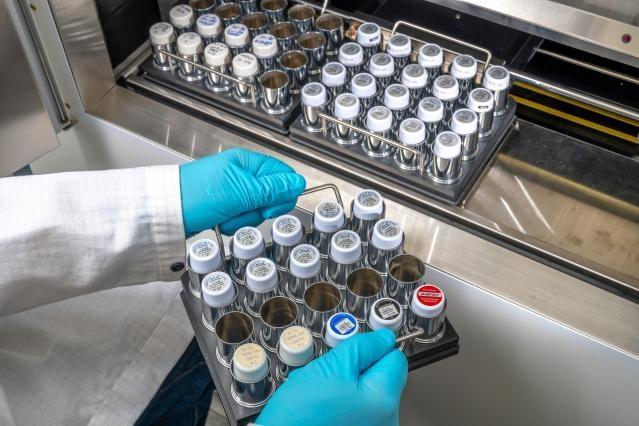
A dedicated controlled area for preparing radioactive sources of different types. This laboratory is equipped with state-of-the-art mass metrological equipment so that very precise sources can be made. Some of the available techniques are precision weighing, ampoulation, foil preparation, drop deposition, vacuum evaporation, electrodeposition.
Chemical Laboratory
This relatively small but fit-for-purpose laboratory is used for advanced chemical separation methods and to prepare samples from various matrices by isolating the necessary elements.
Methods for primary standardization
Primary methods are those methods where one in principle does not need to calibrate the detector. Here the activity follows from basic physical principles. An example of one technique is 4πβ-γ-coincidence counting, another is defined solid angle X-ray or alpha-particle counting. In specific applications, also liquid scintillation counting is considered a primary method. It is not always evident which method is most suitable for a specific radionuclide. Therefore it is important to have access to different methods to discover bias or problems with a certain method.
Methods for secondary standardization
Secondary methods are those methods where it is explicitly needed to calibrate a detector. Amongst these methods there are gamma-ray spectrometry, alpha-particle spectrometry and measurements using ionisation chambers. These methods are highly used as some of them (e.g. gamma-ray spectrometry) require little sample preparation and have the possibility of generating data for several radionuclides in one analysis. These methods are commonly used in industry so it is essential for us to use these techniques not only for fully characterising reference materials but also to be able to give training and advice on these techniques.
Access to the Joint Research Centre (JRC) is subject to special conditions and requirements that are summarized in the document Information for CERIC users requesting access to the JRC. Please read the document before requesting access to RADMET through CERIC open access Calls for Proposals.
More information can be found in the laboratory’s webpage.
Contacts:
HULT Mikael – Mikael.HULT@ec.europa.eu
PELCZAR Krzysztof – Krzysztof.PELCZAR@ec.europa.eu