


JRC GELINA Neutron Time-of-Flight Facility
EUROPEAN COMMISSION’S JOINT RESEARCH CENTRE (JRC) IN GEEL, BELGIUM
The European Commission’s Joint Research Centre (JRC) provides independent, evidence-based science and knowledge, supporting EU policies to positively impact society. The JRC has six sites in five European countries: Brussels and Geel in Belgium, Ispra in Italy, Karlsruhe in Germany, Petten in the Netherlands and Seville in Spain.
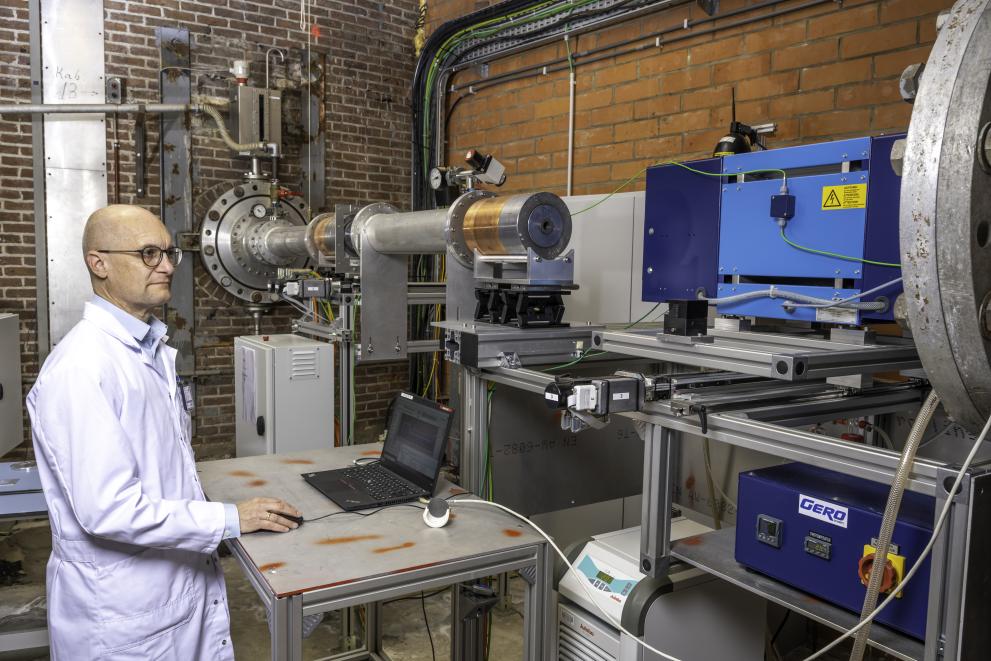
Among the pulsed white spectrum neutron sources available in the world, the linear electron accelerator facility in Geel (GELINA), is the one with the best time resolution.
GELINA combines four specially designed and distinct units: a high-power pulsed linear electron accelerator, a post-accelerating beam compression magnet system, a mercury-cooled uranium target, and flight paths with measurement equipment.
The GELINA neutron source is based on a linear electron accelerator producing electron beams. A typical beam operation mode uses 100 MeV average energy, 10 ns pulse length, 800 Hz repetition rate, 12 A peak and 100 µA average current. With a post-acceleration pulse compression system, the electron pulse width can be reduced to approximately 1 ns (FWHM) while preserving the current, resulting in a peak current of 120 A. The accelerated electrons produce Bremsstrahlung in a uranium target which in turn, by photonuclear reactions, produces neutrons. Within a 1 ns pulse a peak neutron production of 4.3 x 10¹⁰ neutrons is achieved (average production rate of 3.4 x 10¹³ neutrons/s).
The neutron energy distribution emitted by the target ranges from subthermal to about 20 MeV, with a peak at 1-2 MeV. To have a significant number of neutrons in the energy range below 100 keV, a hydrogen-rich moderator is added. The partially moderated neutrons have an approximate 1/E energy dependence plus a Maxwellian peak at thermal energy. By using collimators and shadow bars moderated or unmoderated neutron beams are selected for the twelve neutron flight paths. Further tailoring of the spectral shape is done with filters.
Three experimental stations are available to CERIC users, allowing Transmission measurements (NRTA), Capture measurements (NRCA), as well as detector testing measurements. Arrangements are flexible allowing installation of new equipment to meet new requirements. GELINA is a multi-user facility serving up to 12 different experiments simultaneously. The facility is operated in shift work on a 24 hours/day basis, for about 100 hours per week.
Access to the Joint Research Centre (JRC) is subject to special conditions and requirements that are summarized in the document Information for CERIC users requesting access to the JRC. Please read the document before requesting access to GELINA Neutron Time-of-Flight Facility through CERIC open access Calls for Proposals.
Contacts:
PLOMPEN Arjan –Arjan.PLOMPEN@ec.europa.eu
PARADELA DOBARRO Carlos – Carlos.PARADELA-DOBARRO@ec.europa.eu
More information can be found in the laboratory’s webpage