



Less (sodium) is more: a novel strategy to develop better battery cathodes
|Sodium-ion batteries are attracting growing attention as a potential alternative to lithium-based ones, especially because sodium is abundant and cheap. But developing cathode materials that combine high capacity with durability and sustainability remains a major challenge.
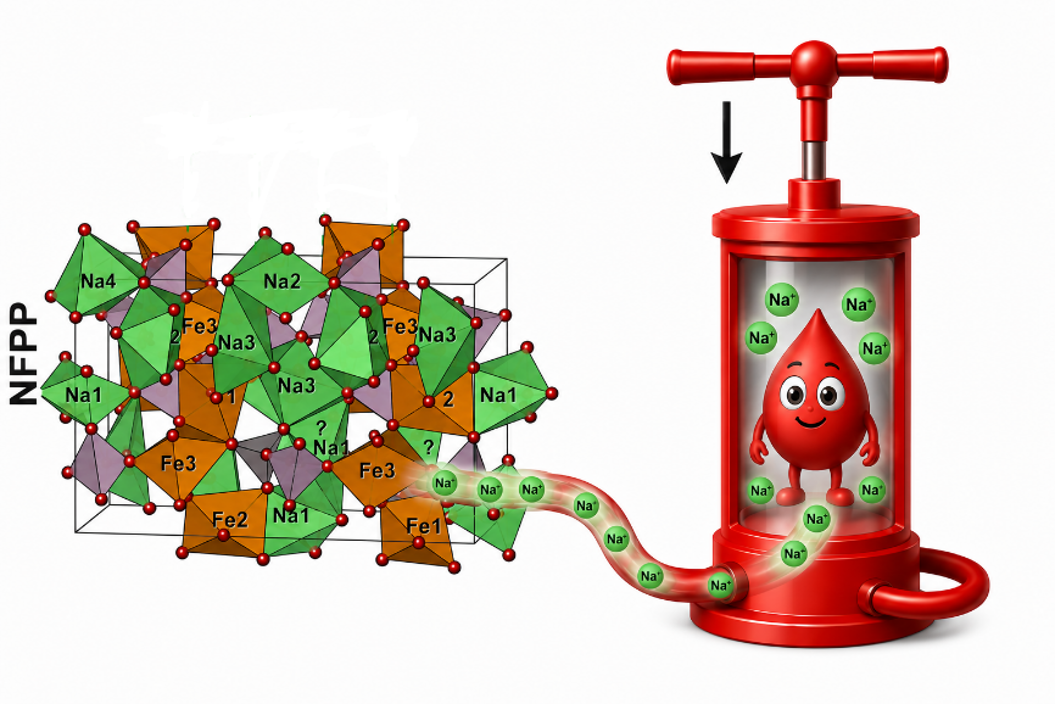
Milica J. Vujković, Alen Vizintin, Matej Gabrijelčič, Olivera Lužanin and Robert Dominko at the National Institute of Chemistry (Ljubljana, Slovenia), together with colleagues from the University of Belgrade (Serbia) and the Jožef Stefan Institute (Ljubljana, Slovenia), explored an intriguing strategy: introducing sodium deficiency into the mixed phosphate–pyrophosphate cathode Na₄Fe₃(PO₄)₂P₂O₇. The result is a single-phase material of composition Na₃.₁Fe₃(PO₄)₂P₂O₇, produced through carefully controlled gel-combustion synthesis, in which the missing sodium is charge-compensated by Fe³⁺ ions. Surprisingly, this apparent imperfection does not reduce the initial electrochemical performance. Nuclear magnetic resonance (NMR) experiments performed with the MAGIC spectrometer at the CERIC Slovenian Partner Facility provided complementary insight into the local structure and sodium environments of the material, helping to identify which sodium sites are particularly vulnerable during cycling, hence connect the atomic-scale disorder of Na₃.₁Fe₃(PO₄)₂P₂O₇ with its electrochemical behavior.
The study also exposes an important trade-off: deeper cycling progressively destabilizes disordered sodium sites and, eventually, the crystalline framework. Narrowing the voltage window, however, dramatically improves stability, reducing capacity loss to 0.018% per cycle over 1000 cycles at 1C rate.
ORIGINAL ARTICLE: