



Hybrid Photoanodes for solar fuels: when molecular catalysis makes the difference
|Turning sunlight into fuel is one of the most compelling challenges in modern energy research. Photoelectrochemical (PEC) cells aim to do that, converting solar energy into hydrogen – a clean fuel with exceptional energy density – by splitting water. Among the most promising materials for this task are metal oxide semiconductors such as BiVO₄ and WO₃, valued for their stability and affordability. However, their performance is often limited by inefficient charge transport and rapid recombination of photogenerated carriers.
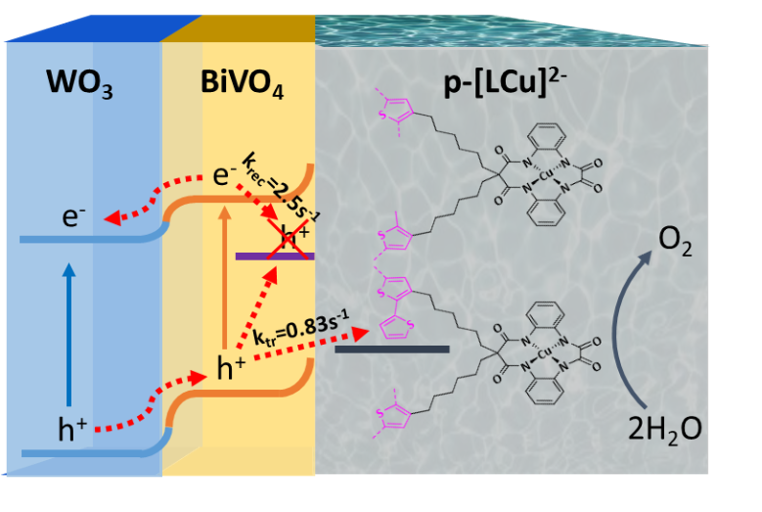
The result is a marked improvement in device performance: charge recombination is reduced by 62%, while the catalyst actively mediates hole transfer to water, enhancing both efficiency and stability during prolonged operation. Rather than acting as a passive coating, the copper complex plays a dynamic role in facilitating the oxygen evolution reaction.
ORIGINAL ARTICLE
Hybrid Molecular Photoanodes for Water Oxidation Based on Electropolymerized Cu Macrocyclic Complexes on BiVO4-WO3
Bellido C.G., Mazzanti M., Ranu K., Piccioni A., Mazzaro R., Boscherini F., Salomón F.F., Grau S., Sala X., Pasquini L., Llobet A., Caramori S., Advanced Energy Materials, 2025