


A two-step oxidation mechanism explains how even gold can corrode
|Gold is often regarded as the best example of chemical stability and resistance to corrosion. In electrochemistry, this apparent inertness has made it a preferred model surface for studying reactions and building reliable sensors or energy devices. However, a new research reveals that gold is far more dynamic than previously assumed.
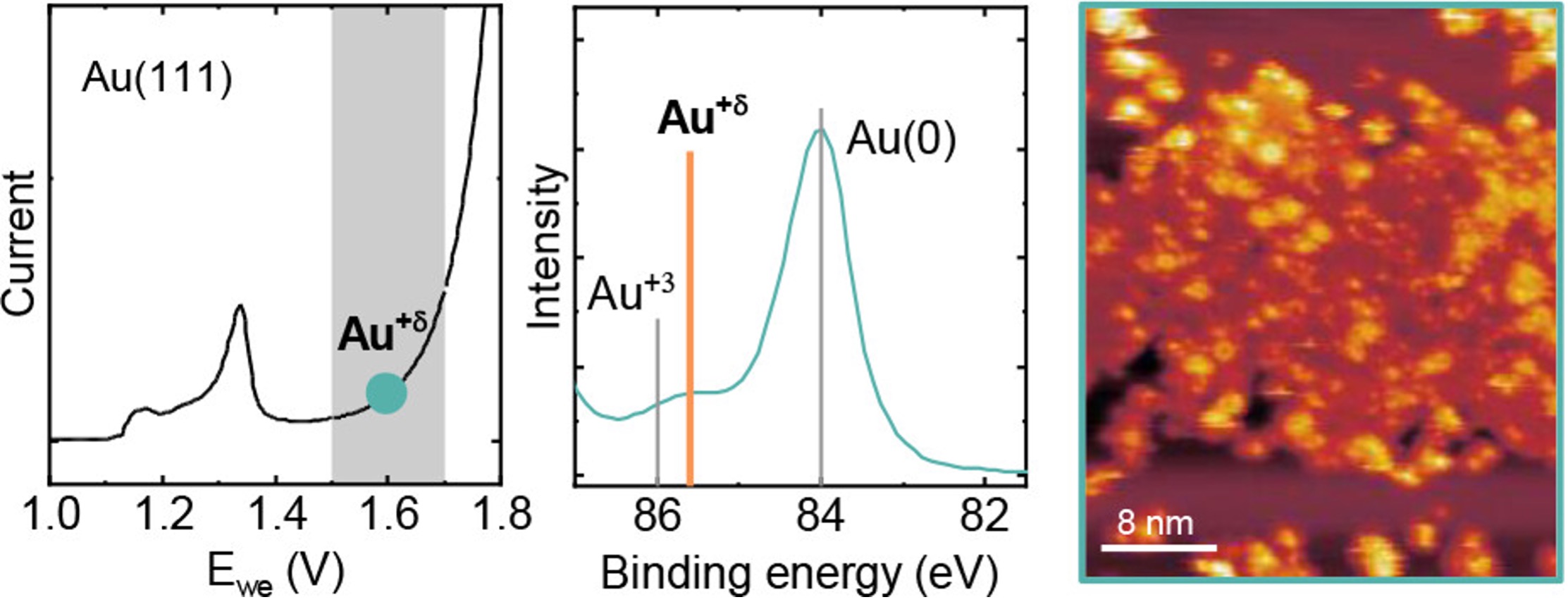
Sara Barja and Ane Etxebarria (University of Basque Country), Jesús Redondo, Pankaj Samal and Josef Mysliveček(Charles University Prague) and colleagues uncovered direct evidence for an intermediate oxidation state, described as Auδ+ (where 0 < δ < 3), formed during electrochemical oxidation of Au(111), the close-packed (111) surface of gold. This transient phase appears before the formation of the fully oxidized Au3+ state traditionally considered the thermodynamic endpoint of gold oxidation, challenging the long-standing “one-step” model in which metallic gold converts directly into Au3+. Exploiting quasi-in situ X-ray photoelectron spectroscopy combined with low-temperature scanning probe microscopy under ultrahigh vacuum available at the Czech Partner Facility, which enabled direct visualisation and characterisation of the metastable Auδ+ surface oxide at atomic resolution, researchers discovered and described a two-step mechanism: first, a thin amorphous surface oxide forms, and only later does bulk-like Au3+ develop. This intermediate phase may play a key role in catalytic processes such as water electrolysis and alcohol oxidation and allows more accurate theoretical predictions of reaction pathways.
Beyond a fine description of gold electrochemistry, these insights suggest that multistep oxidation pathways could represent a general mechanism shared among noble metals.
ORIGINAL ARTICLE