


Engineering crystalline films for greater MOFs stability and performance
|Metal–organic frameworks (MOFs) are porous crystalline materials with high internal surface areas, allowing them to accommodate and interact with molecules within their pores. This makes them promising for gas separation, sensing, and optoelectronics. Recent studies have shown that their performance depends not only on their chemical composition, but also on how their crystals are oriented on the surface on thin film.
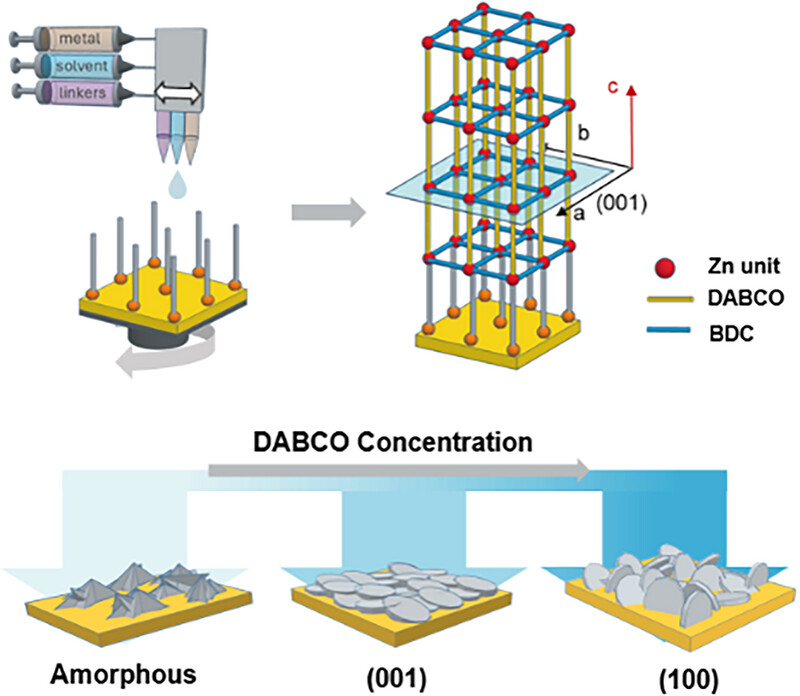
CERIC researcher Eleonora Afanasenko, Sumea Klokic (TU Graz, University of Primorska), Benedetta Marmiroli (TU Graz) and colleagues developed an automated highly reproducible method to fabricate oriented MOF thin films using spin-assisted layer-by-layer liquid-phase epitaxy (LbL-LPE). The approach – which researchers have established on Zn₂BDC₂DABCO, a flexible MOF known for its responsiveness to external stimuli – combines rapid deposition cycles with software-controlled monitoring of key parameters, including reagent concentrations, substrate functionalization and spinning speed. In particular, by fine-tuning the molar ratio of zinc and organic linkers, scientists synthesized homogeneous films with exceptional crystallographic alignment, which ultimately improved resistance to prolonged exposure to 80% relative humidity – a significant improvement considering that the same MOF in powder form rapidly degrades already at around 50% relative humidity.
Insights into the structural organization and comprehensive characterisation of the MOF thin films were obtained using advanced techniques, including the ones offered at the SAXS (CERIC Austrian Partner Facility) and SISSI-Bio (CERIC Italian Partner Facility) beamlines at Elettra Sincrotrone Trieste. Operating under ambient conditions, the fabrication process also reduces solvent and reagent consumption compared with conventional methods, offering a promising route towards more sustainable and reproducible manufacturing.
By linking precise fabrication to enhanced stability, this study opens new possibilities for MOF-based membranes, sensors and optoelectronic devices based on a highly controlled material’s architecture.
ORIGINAL ARTICLE:
Automated Spin-Assisted Layer-by-Layer Epitaxy Produces Highly Oriented Mixed-Linker MOF Thin Films
Afanasenko E., Marmiroli B., Abbasgholi Nejad Asbaghi B., Sartori B., Birarda G., Stani C., Finšgar M., Hartmann P.E., Bieber M., Walitsch E., Breinbauer R., Dal Zilio S., Klokic S., Amenitsch H., Angewandte Chemie – International Edition, 2026