



A multilayer approach for more resistant solar fuel electrodes
|Photoelectrochemical (PEC) technologies aim to convert sunlight directly into chemical fuels. In these systems, semiconductor electrodes absorb solar energy and drive reactions that transform small molecules, such as water, nitrate, or carbon dioxide, into useful products like hydrogen, ammonia, or methanol. A key challenge in these devices is the design of efficient and stable photoelectrodes: semiconductors such as silicon are particularly attractive because they absorb a broad portion of the solar spectrum and can generate high photocurrents. However, these materials are chemically unstable in aqueous environments: silicon and similar semiconductors can corrode quickly when immersed in electrolytes, especially under strongly acidic or alkaline conditions.
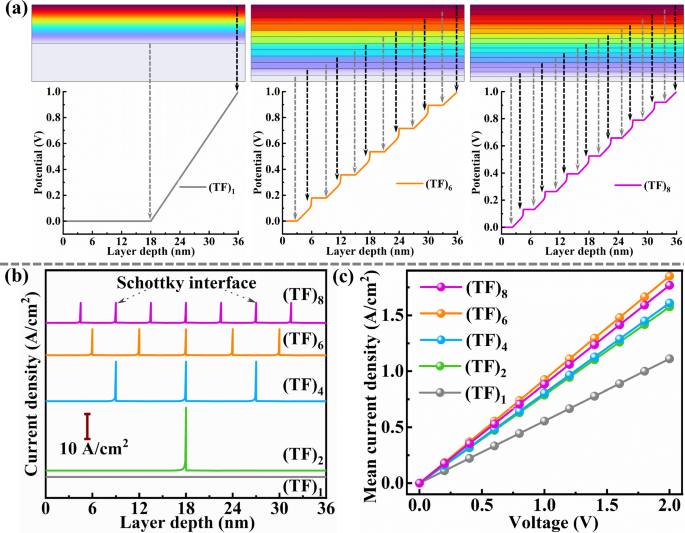
To prevent degradation, researchers often add protective coatings that separate the semiconductor from the electrolyte. The difficulty is to find a balance, since that protection and performance often conflict: very thin oxide coatings allow electrical charges to tunnel through efficiently, but they do not provide long-term corrosion resistance. On the other hand, thicker oxide layers offer better durability, but they slow charge transport and reduce device efficiency.
To overcome this stalemate, Prof. Jianyun Zheng (Hunan University) partnered with Prof. Roland De Marco (Curtin University, Perth) and colleagues for synchrotron characterisation of his materials, proposed a multilayer protection strategy: instead of a single oxide film, the coating consists of alternating oxide and metal layers arranged in repeating nanoscale units. Then, using several analytical techniques, including the ones available at the Materials Science Beamline of the CERIC Czech Partner Facility at Elettra Sincrotrone Trieste, researchers analysed the properties and behaviour of the proposed system. Scientists then proved that by carefully tuning the number and thickness of these layers the structure creates multiple charge-tunnelling pathways that improve electrical transport while maintaining a relatively thick, durable coating. In particular, using silicon photocathodes designed for solar-driven ammonia production, the team showed that an optimised multilayer structure significantly improved charge-transfer rates and conversion efficiency, minimising unwanted light reflection or absorption.
ORIGINAL ARTICLE: