



A new generation of photocathodes can turn CO₂ into ethanol with sunlight
|What if carbon dioxide could become not just a greenhouse gas to be removed, but a raw material for producing useful chemicals, such as ethanol? This is theoretically possible combining cuprous oxide (Cu₂O), a visible-light-absorbing semiconductor. However, a big obstacle still remains: Cu₂O rapidly undergoes photocorrosion in water, making the catalytic process rather unstable.
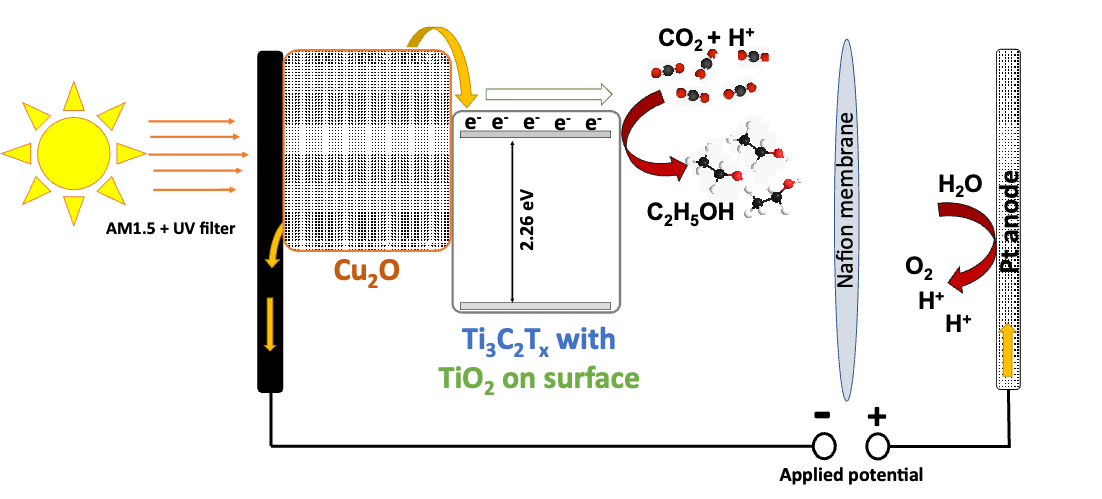
Pavla Eliášová, Luis A.M. Carrascosa,Tomáš Hrbek and colleagues of Charles University Prague addressed this weakness by carefully engineering the Ti₃C₂Tₓ MXene, which is a highly conductive two-dimensional material. They modified its surface so that a thin layer of TiO₂ forms in situ. Using state-of-the-art characterisation techniques, such as the Electron Spectroscopy for Chemical Analysis under Environmental Conditions (EnviroEsca) instrument available at CERIC Czech Partner Facility, researchers shown that, rather than acting mainly as another light absorber, this TiO₂ layer helps separate and transport charges (while the MXene provides an efficient pathway for electrons).
The resulting “nano-sandwich” photocathode achieved good ethanol production rate and solar-to-ethanol efficiency after two hours. Importantly, it retained 76% of its initial production rate after six hours, and continued producing ethanol after ten hours of operation. Ethanol was also the only liquid product detected under the tested conditions. The next challenge is scaling the technology beyond the laboratory and testing it under real sunlight.
ORIGINAL ARTICLE: