


PRESS RELEASE | Researchers reveal the science and hidden stories behind centuries-old tattoos
|A multidisciplinary research uncovers the chemistry, cultural traditions, and personal stories behind rare, tattooed skin fragments from 19th-century, illuminating a unique aspect of Italian cultural history.
Trieste (Italy), 12 January 2026 – A groundbreaking research project, supported by the European Research Infrastructures Consortium CERIC-ERIC, has shed new light on one of the most unusual and little-known chapters of human history: how human skin used to be tattooed – and then preserved – centuries ago.
The study, recently published in the journal Heritage Science, combines history, chemistry, anthropology, and conservation science to better understand and protect rare tattooed skin fragments, many over a century old, held in the historic “Luigi Cattaneo” Anatomical Wax Collection at the University of Bologna. The research, which involved a multidisciplinary team from CERIC-ERIC, the Italian Space Agency (ASI), Elettra Sincrotrone Trieste, the University of Bologna, the University of Rome “Tor Vergata” and the Abdus Salam International Centre for Theoretical Physics (ICTP), offers a unique window into past tattooing practices, cultural traditions, and the ways museums once collected and studied the human body.
Tattooing is an ancient human practice found across cultures and eras, from the 5,000-year-old tattooed “Ötzi” mummy discovered in the Alps to medieval Christian pilgrims who marked their bodies as signs of faith. But alongside this rich history lies a darker legacy: the collection of tattooed human skin by early scientists, criminologists, and museums, particularly during the 19th century. At that time, tattoos were mistakenly viewed as signs of criminality or “primitive ” behavior, ideas promoted by influential but now-discredited figures such as Italian criminologist Cesare Lombroso. This led to the preservation of tattooed skin in museums and research institutions across Europe.
The tattooed fragments studied in this research primarily represent the Loreto tattooing tradition – a devotional practice geographically confined to central Italy and intimately connected to pilgrimages to the Holy House of Loreto, a major Catholic sanctuary in the Marche region.
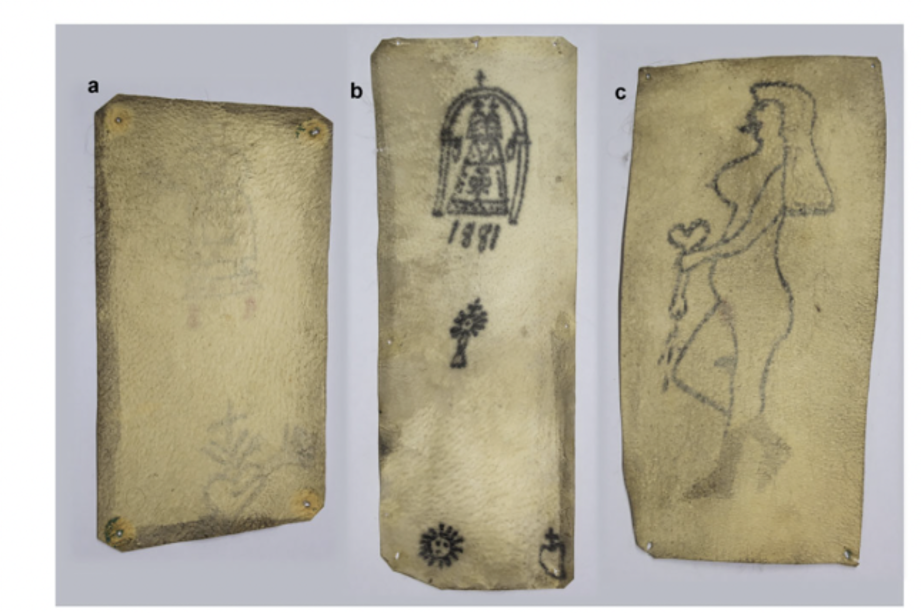
The tattoo, performed with rudimentary three-pointed iron tools, became a permanent ex-voto, a physical bond with the divine imprinted on the skin – primarily on the wrists – recalling the stigmata of Christ and Saint Francis. Alongside sacred symbols, profane and erotic tattoos also emerge, evidence of a popular culture that mixed devotion and carnality without apparent contradiction. “The differences observed among the specimens, which suggest individuals of varying ages,” adds Stefano Ratti, Professor of Human Anatomy at the University of Bologna and scientific expert of the “Luigi Cattaneo” Anatomical Wax Collection, “indicate that these people carried their tattoos throughout their lives—indelible marks of moments that defined their spiritual and social identity in an era when the body itself became a book of memory”.
The tattooed skin pieces were rediscovered only recently in museum storage. With little documentation surviving about their origins, researchers saw an opportunity to study them with modern, non-invasive investigation methods that would protect the extremely fragile specimens while revealing their secrets: “Through advanced spectroscopic analyses conducted at Elettra Sincrotrone Trieste – explains Chiaramaria Stani, former CERIC researcher who is now beamline scientist at Elettra – we identified traditional pigments such as plant-based carbon black for black tattoos, natural earth pigments for browns, and a mixture of cinnabar and minium for reds. But we also discovered traces of zinc and lime compounds, possibly suggesting the museum conservation methods of the time. This multidisciplinary approach allows us to document a nearly extinct cultural practice and develop specific conservation protocols for these unique materials.”
This research offers valuable insights into the moral, social, and religious dimensions of tattooing in 19th century Italy, contributing to the understanding of tattooing evolution from a devotional and identity-based practice to a contemporary art form. It also establishes a framework for museums worldwide that care for similar materials—many of which also lack documentation or face conservation challenges. Future investigations aim to expand the scientific techniques used and explore archival sources to better understand who these individuals were and how their tattooed skin came to be preserved. The research team also emphasizes the importance of addressing the ethical dimensions of studying and exhibiting human remains, recognizing them as sensitive materials that require respectful treatment while acknowledging their cultural and scientific value.
The study, Scientific analysis and preservation protocols for tattooed skin specimens from “Luigi Cattaneo” anatomical wax collection, is available at the following link: https://doi.org/10.1038/s40494-025-02132-9
—
CERIC-ERIC is a European research infrastructure consortium established by the European Commission and the Government of eight Countries in 2014. It offers researchers and industry access to more than 60 experimental analytical and synthesis techniques in advanced research facilities in eight Central and Eastern European countries, and associated institutions. This supports multidisciplinary research down to the micro- and nano-level in the fields of advanced materials, biomaterials and nanotechnology. In CERIC’s facilities, materials can be analysed and their structure investigated by combining techniques based on the use of electrons, ions, neutrons and photons.
Access to CERIC’s research services is through international calls for proposals that allow free access to multiple techniques and reward the best projects, provided their results are open and published. In addition, there is commercial access for proprietary research open to companies, and support for technology transfer.
CONTACTS:
CERIC Press Office: press@ceric-eric.eu
-
02.04.2026
CERIC Newsletter | April 2026