Tattooing is an ancient human practice found across cultures and eras, but alongside this rich history lies a darker legacy: the collection of tattooed human skin by early scientists, criminologists, and museums, particularly during the 19th century.
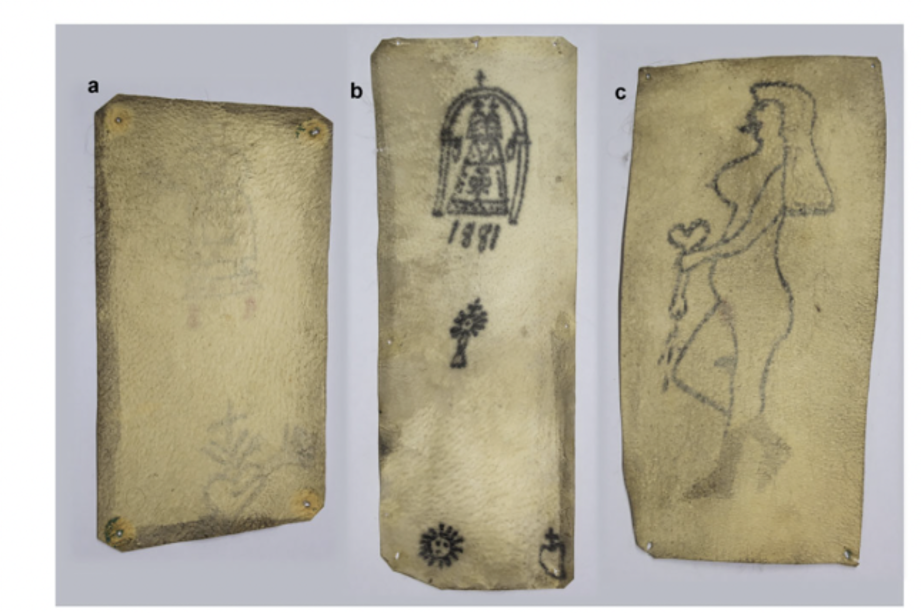
Selected skin fragments that have been analysed, which contains religious (a and b) as well as erotic (c) tattoos [from Vadrucci et al., 2025, Heritage Science]Monia Vadrucci (Italian Space Agency), Stefano Ratti (University of Bologna), Chiaramaria Stani (former CERIC researcher, now beamline scientist at Elettra Sincrotrone Trieste) and colleagues studied tattooed skin fragments held in the historic “Luigi Cattaneo” Anatomical Wax Collection at the University of Bologna, primarily representing the Loreto tattooing tradition. With little documentation surviving about their origins, researchers saw an opportunity to study them with modern, non-invasive investigation methods, such as advanced spectroscopic analyses available at CERIC Italian Partner Facility. Scientists could then identify traditional pigments such as plant-based carbon black for black tattoos, natural earth pigments for browns, and a mixture of cinnabar and minium for reds. But they also discovered traces of zinc and lime compounds, possibly suggesting the museum conservation methods of the time.
The tattoos, that testified pilgrimages made to the Sanctuary of the Holy House and were performed with rudimentary three-pointed iron tools, became a permanent ex-voto, a physical bond with the divine imprinted on the skin; moreover, the differences observed among the specimens suggest individuals of varying ages, indicating that these people carried their tattoos throughout their lives, to immortalises crucial moments.